NeuroMD vs. TENS: What's the Difference for Back Pain?

The NeuroMD Corrective Therapy Device® is not a traditional TENS unit. It uses neuromuscular electrical stimulation (NMES) to stimulate motor nerves and produce muscle contractions. This is different from transcutaneous electrical nerve stimulation (TENS), which primarily stimulates sensory nerves and is commonly used for temporary pain relief or pain modulation. Both are established forms of electrical stimulation therapy — they're just built to do different jobs.
This guide compares NeuroMD and traditional TENS units directly: what each device does, how the underlying technology differs, and what to consider when deciding which type of device fits your situation.
Is NeuroMD a TENS Unit?
No. The NeuroMD Corrective Therapy Device® uses neuromuscular electrical stimulation (NMES) rather than traditional TENS stimulation. The distinction matters because TENS and NMES are designed around different physiological targets: TENS primarily stimulates sensory nerves, while NMES stimulates motor nerves to produce muscle contractions.
What Is a TENS Unit?
A TENS (transcutaneous electrical nerve stimulation) unit is an electrotherapy device that delivers low-voltage electrical current through electrodes placed on the skin, primarily to stimulate sensory nerves. TENS devices are regulated by the FDA as transcutaneous electrical nerve stimulators for pain relief (21 CFR 882.5890) and are commonly used for temporary, localized pain relief or pain modulation.
TENS units are widely available for consumer use, are typically simple to operate, and are often used during activity because they generally don't produce strong muscle contractions. They are one of the most common at-home electrotherapy devices on the market.
What Is NeuroMD?
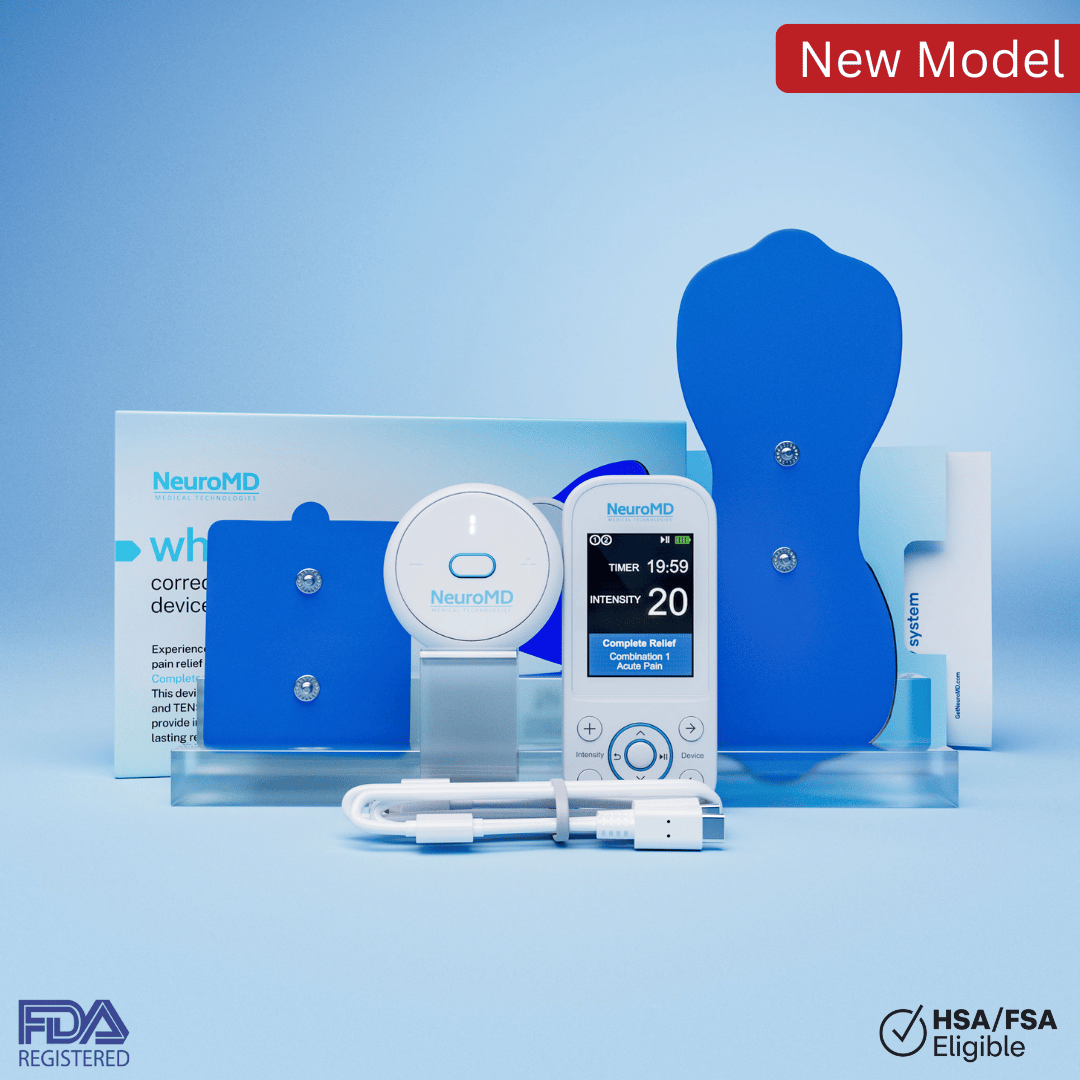
The NeuroMD Corrective Therapy Device® is an FDA 510(k)-cleared medical device that uses neuromuscular electrical stimulation (NMES) to stimulate motor nerves and produce muscle contractions. It's designed for at-home use as part of a back-pain therapy routine.
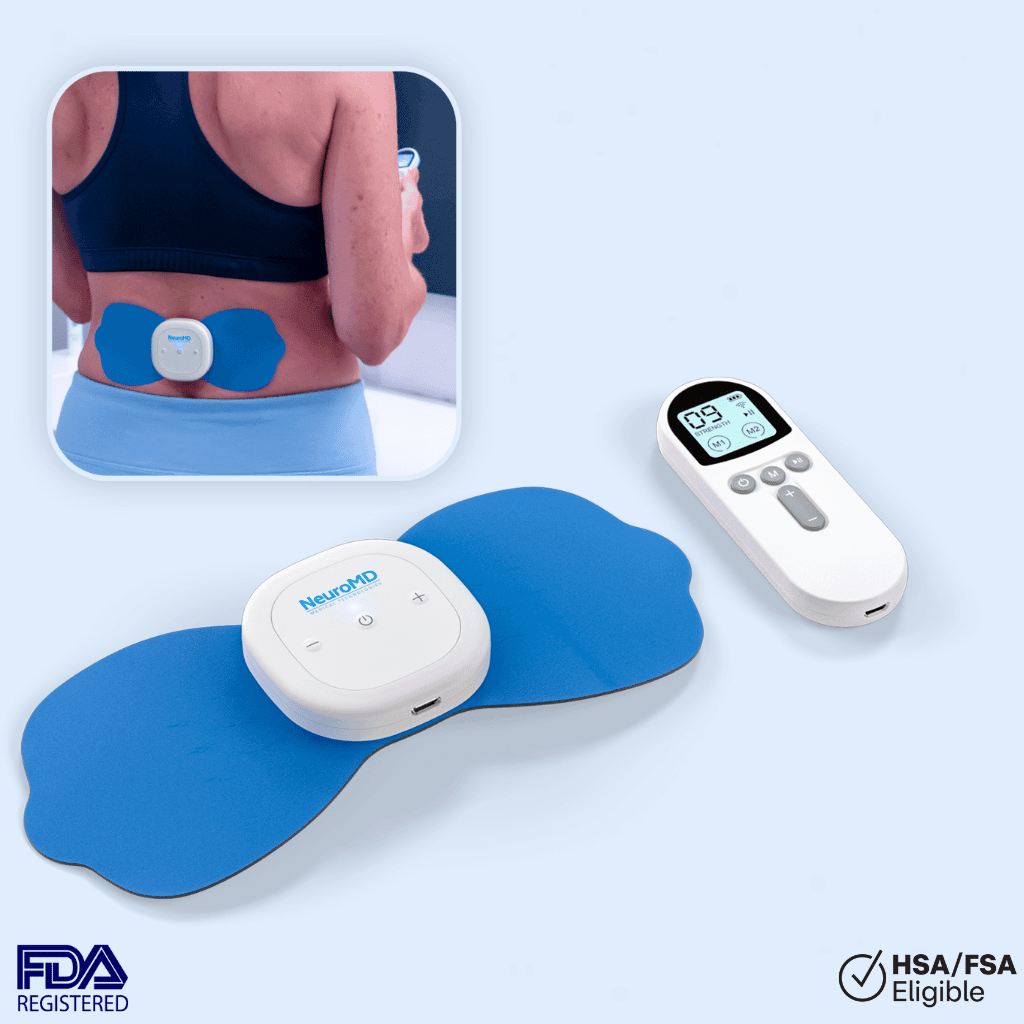
Rather than targeting sensory nerves the way TENS does, NeuroMD's electrodes are placed over target muscle groups in the lower back to stimulate motor nerves, causing the muscles to contract and relax in a controlled, repeatable pattern. The device offers adjustable intensity so users can set stimulation to a level appropriate for them, within guidance provided in the product instructions.
NeuroMD vs. TENS: Side-by-Side Comparison
The table below summarizes the core factual differences between NeuroMD (an NMES device) and a traditional TENS unit. It is not a ranking — the two technologies are designed for different purposes.
| Attribute | NeuroMD (NMES) | Traditional TENS Unit |
|---|---|---|
| Stimulation type | Neuromuscular electrical stimulation (NMES) | Transcutaneous electrical nerve stimulation (TENS) |
| Primary nerve target | Motor nerves | Sensory nerves |
| Muscle contraction | Yes — designed to produce visible, controlled muscle contractions | Generally minimal to none; not designed to elicit strong contractions |
| Typical purpose | Muscle activation as part of an at-home lower-back therapy routine | Temporary, localized pain relief or pain modulation |
| At-home use | Yes — designed for at-home use (FDA 510(k)-cleared medical device) | Many consumer TENS units are also designed for at-home/over-the-counter use |
| Adjustable intensity | Yes | Yes |
How Does TENS Work?
TENS works by delivering electrical stimulation through electrodes on the skin to stimulate sensory nerves. It is commonly used for temporary pain relief or pain modulation. TENS devices are typically set to intensities that produce a tingling sensation rather than a muscle contraction.
For a deeper technical breakdown of TENS parameters like frequency, waveform, and pulse duration, see our companion article, NMES vs. TENS: Key Differences.
How Does NeuroMD's NMES Technology Work?
NeuroMD works by delivering electrical stimulation through skin electrodes to motor nerves, which causes the connected muscles to contract and then relax in a controlled cycle. Electrodes are placed over target muscle groups in the lower back, and the device's programmed settings determine the contraction pattern for each session.
This mechanism — motor nerve stimulation leading to muscle contraction — is what separates NMES from TENS at a physiological level. For a closer look at how this applies specifically to spinal-stabilizing muscles and what the supporting research shows, see NMES for Back Pain: How Neuromuscular Electrical Stimulation Works.
Key Differences Between NeuroMD and TENS
- Nerve target: NeuroMD (NMES) stimulates motor nerves; TENS stimulates sensory nerves.
- Physical effect: NMES produces visible muscle contractions; TENS generally does not.
- Primary goal: NMES is used for muscle activation as part of a therapy routine; TENS is used for temporary pain modulation.
- Sensation during use: NMES typically feels like a rhythmic muscle contraction and release; TENS typically feels like a tingling or buzzing sensation.
Is NMES an Alternative to TENS?
NMES and TENS are different technologies with different intended purposes, so "alternative" isn't quite the right frame — they're not interchangeable tools solving the same problem. Someone whose primary goal is temporary sensory pain relief is using TENS for what it's built to do. Someone whose goal is muscle activation as part of a lower-back therapy routine is looking for what NMES is built to do. Some people use both, at different times or for different goals, rather than choosing one over the other.
NeuroMD does not claim to be a universal replacement for TENS, and this article does not claim that NMES is better than TENS for every person or every use case.
How Do You Choose Between NMES and TENS?
The right choice depends on what you're trying to accomplish, your medical history, and guidance from a healthcare provider. A few neutral considerations:
- What's the goal? If the goal is temporary relief of sensory discomfort, TENS is designed for that. If the goal is muscle activation as part of a structured back-pain routine, NMES is designed for that.
- Do you want muscle contraction or not? NMES is built to produce it; TENS generally is not, which is why some people prefer TENS during activity or work.
- What does a healthcare provider recommend? A physician or physical therapist can advise on which modality — or combination — fits a specific condition.
- What are the contraindications? Both technologies carry safety considerations (see below) that should be reviewed before use.
- Is this a standalone treatment or part of a broader routine? Both TENS and NMES are typically used alongside — not instead of — other guidance from a healthcare provider.
What Does Research Say About NMES and Back Muscles?
Research on NMES generally supports its ability to activate muscles, including spinal-stabilizing muscles in the lower back, when electrodes are placed over the appropriate muscle groups. A 2024 systematic review and meta-analysis in Frontiers in Pain Research examined electromyostimulation (EMS/NMES), interferential current, and TENS for chronic low back pain and found limited evidence that EMS was superior to passive controls for pain, with mixed results for disability outcomes — the review did not find any of these modalities to be consistently superior to active exercise-based care.
Most published research in this area evaluates NMES technology or specific NMES protocols rather than the NeuroMD device itself. Findings from general NMES research therefore shouldn't be interpreted as clinical evidence for NeuroMD specifically. For a more detailed look at the research on NMES and lower-back muscle activation, see NMES for Back Pain: How Neuromuscular Electrical Stimulation Works and the full list of studies referenced on our clinical studies page.
Safety and Contraindications
Electrical stimulation isn't appropriate for everyone. Contraindications, warnings, and precautions vary by device. FDA guidance for powered muscle stimulators identifies considerations involving implanted electronic devices, pregnancy, certain heart conditions, epilepsy, recent surgery, impaired sensation, and electrode placement, among others. These general considerations don't automatically apply the same way to every device, including NeuroMD — always review the instructions, warnings, and contraindications for the specific device you're using and consult a healthcare professional if you're unsure whether electrical stimulation is appropriate for you.
Where NeuroMD Fits
For someone comparing a traditional TENS unit with an NMES device, the key distinction is the type of stimulation you're looking for. The NeuroMD Corrective Therapy Device® is an FDA 510(k)-cleared medical device that uses NMES to stimulate motor nerves and produce muscle contractions in targeted back muscles.
Learn more about the NeuroMD Corrective Therapy Device, including its features, instructions, and important safety information.
Frequently Asked Questions
Is NeuroMD a TENS unit?
No. NeuroMD is an NMES (neuromuscular electrical stimulation) device. It's designed to stimulate motor nerves and produce muscle contractions, which is different from a TENS unit's design around sensory nerve stimulation for temporary pain relief.
What's the difference between NeuroMD and a TENS unit?
NeuroMD targets motor nerves to produce muscle contractions (NMES), while a TENS unit targets sensory nerves for temporary pain relief or modulation. The two serve different primary purposes based on this physiological difference.
Is NMES the same as TENS?
No. NMES and TENS are both forms of electrical stimulation delivered through skin electrodes, but they target different nerve types and produce different effects — NMES produces muscle contractions by stimulating motor nerves, while TENS is designed to affect sensory nerves without producing strong muscle contractions.
Is NMES an alternative to TENS?
NMES and TENS are different technologies built for different goals, so NMES isn't a direct substitute for TENS in every situation. Some people use one or the other depending on their goal — muscle activation versus temporary sensory pain relief — and some use both.
Does NeuroMD use TENS?
No. NeuroMD's design and intended use are built around NMES (neuromuscular electrical stimulation) — stimulating motor nerves to produce muscle contractions — rather than TENS.
Can NMES activate lower-back muscles?
Yes. When electrodes are placed over the appropriate muscle groups, NMES is designed to stimulate motor nerves and cause lower-back muscles, including spinal-stabilizing muscles, to contract. Research on NMES generally — not always involving the NeuroMD device specifically — has studied this effect in populations with chronic low back pain.
Can NMES be used at home?
Some NMES devices are designed for at-home use. NeuroMD is an FDA 510(k)-cleared medical device designed for at-home use. Users should follow the product's instructions, warnings and contraindications.
Sources & Further Reading
- U.S. FDA / eCFR — 21 CFR 882.5890, Transcutaneous electrical nerve stimulator for pain relief
- U.S. FDA — Guidance Document for Powered Muscle Stimulator 510(k)s
- Wolfe D, Rosenstein B, Fortin M. "The effect of EMS, IFC, and TENS on patient-reported outcome measures for chronic low back pain: a systematic review and meta-analysis." Frontiers in Pain Research, 2024. Read the review
- NMES vs. TENS: Key Differences — NeuroMD educational article
- NMES for Back Pain: How Neuromuscular Electrical Stimulation Works — NeuroMD educational article
- NeuroMD Clinical Studies — full list of referenced research


![How to Prevent Lower Back Pain When Lifting Weights [8 Things to Avoid]](http://getneuromd.com/cdn/shop/articles/iStock-1362387122.jpg?v=1677689984&width=1080)